Prime Day 2026 vs Walmart & Best Buy: Who Wins?

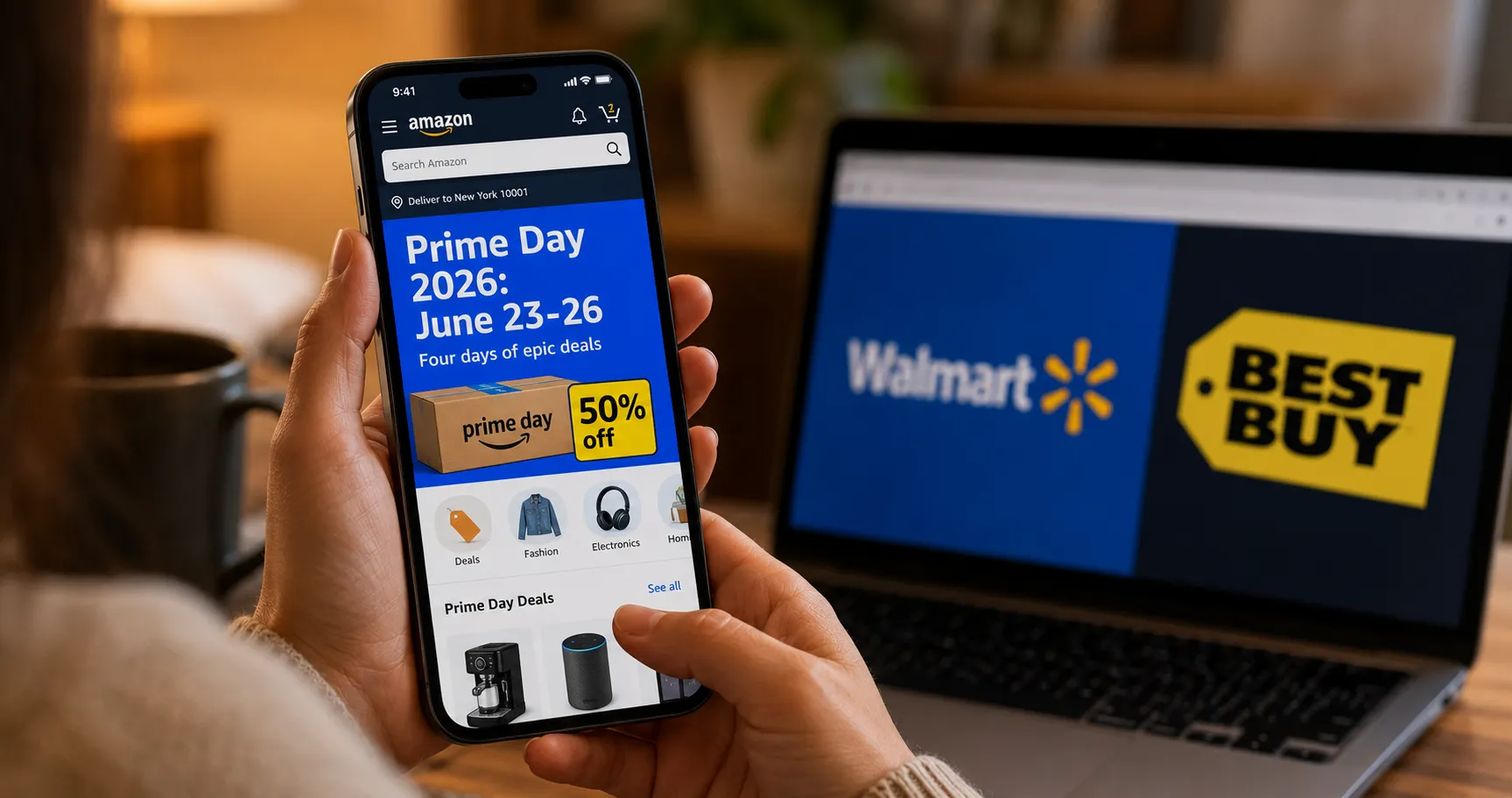
Prime Day 2026 vs Walmart and Best Buy: rival retailers run competing sales June 23-26, so check prices per category before you buy on Amazon by default.
Key Takeaways
- Prime Day 2026 runs June 23-26, and Walmart, Best Buy, Target, Costco, and Sam's Club run competing sales in the same window, per ZDNET.
- Amazon-brand devices like Kindle and Fire TV Stick are hard to beat elsewhere; third-party brands like Apple, Samsung, and Garmin are where checking rival retailers pays off.
- The sources confirm rival sales exist but do not publish head-to-head per-category prices, so check the exact SKU at each store before buying.
On this page
For Prime Day 2026, you should not buy on Amazon by default, because Walmart, Best Buy, and Target are running competing sales across the same June 23-26 window.
That window is the key fact every shopper needs first, and it is the one point all the coverage agrees on.
When is Prime Day 2026 and who is competing?
Amazon Prime Day 2026 runs from Tuesday, June 23 through Friday, June 26, ending at 11:59 p.m. PDT on the final day, according to ZDNET.
That is a four-day event, longer than the two-day sales of earlier years, which changes how you should pace your shopping.
Rival retailers are not sitting it out.
ZDNET reports discounts of over 50% across categories and explicitly names "competing discounts from other retailers like Walmart, Best Buy, Target, Costco, and Sam's Club" during the same period.
The catch is that the scraped coverage confirms these rival sales exist but does not publish a head-to-head price-per-category table across all four retailers, so the comparison below is built from what each source actually verified.
Prime Day 2026 deals by category: what the sources confirm
The most cite-worthy synthesis here is which categories have verified deals and which retailer the price is tied to, because no single outlet laid this out across retailers.
The table normalizes the concrete, sourced data points from the coverage; every price below is an Amazon Prime Day price unless noted, since that is what the sources documented.
| Category | Sourced example + price | Retailer (per source) | Source |
|---|---|---|---|
| Streaming device | Fire TV Stick 4K Plus, $25 (50% off, was $50) | Amazon | ZDNET |
| Streaming device | Google TV Streamer, $80 (20% off, was $100) | Amazon | ZDNET |
| Streaming device | Roku Ultra, $85 (15% off, was $100) | Amazon | ZDNET |
| E-reader | Base Kindle, $85 (was $110, save $25) | Amazon | ZDNET |
| TV | Hisense U7 Mini LED, $999 (50% off, was $1,999) | Amazon | ZDNET |
| Headphones | AirPods Max 2, $399 (27% off, was $549) | Amazon | ZDNET |
| Smartwatch | Garmin (47mm AMOLED), $499 (50% off, was $999) | Amazon | ZDNET |
Each row is a specific, dated price from the source, not an estimate.
What is missing is the matching Walmart or Best Buy price for the same SKU, because the sources did not provide it, and inventing one would be worse than admitting the gap.
Does shopping Amazon by default actually cost you money?
The honest answer from these sources is that you cannot yet prove Walmart or Best Buy beats Amazon on a specific item, only that they are running parallel sales worth checking.
The trade-off is real: Amazon's own-brand hardware, like the Kindle and Fire TV Stick, is discounted directly by Amazon, so a rival retailer is unlikely to undercut Amazon on an Amazon device.
ZDNET notes the base Kindle deal "will likely last through the entirety of Amazon Prime Day, since Kindle is an Amazon-owned product," which is a strong signal that first-party devices are the one category where Amazon is hard to beat.
For third-party brands like Apple, Samsung, Garmin, and Hisense, the logic flips, since any retailer can stock and discount those, which is exactly where a Walmart or Best Buy price check pays off.
The condition to remember is that a lower sticker price only wins if shipping, membership requirements, and return policy match, and Prime Day deals can require a Prime membership to access.
How to actually compare retailers during the window
Use a short, repeatable process rather than trusting any single store's roundup.
- Identify the exact model and SKU you want, not just the product line, since prices differ by configuration.
- Check the Amazon Prime Day price first as your baseline, using the verified figures above as a sanity check.
- Search the same SKU at Walmart, Best Buy, and Target, all of which the source confirms are running competing sales.
- Add shipping and any membership cost to each price before comparing, because Prime-gated deals are not free if you do not already pay for Prime.
- For Amazon-brand devices, default to Amazon, since rivals rarely undercut first-party hardware.
This process turns "who wins" from a guess into a per-item check you control.
If you want the editor-curated Amazon picks instead of a cross-retailer method, the complementary read is our roundup of Prime Day 2026 deals worth buying versus skipping, which curates Amazon SKUs rather than pitting stores against each other.
For one concrete cross-retailer data point, our coverage of the AirPods Pro 3 record low at Walmart shows a case where a rival store, not Amazon, held the lowest price.
References:
- ZDNET, June Prime Day live blog 2026: We're tracking Amazon deals on SSDs, TVs, laptops and more. Accessed on Jun 23, 2026
- ZDNET, I got a Fire TV Stick this Prime Day, and here are other streaming deals I'm watching. Accessed on Jun 23, 2026
- TechRadar, The Elite Workspace: 12 luxury Prime Day upgrades for a timeless office. Accessed on Jun 23, 2026
Frequently asked questions
When is Amazon Prime Day 2026?
Amazon Prime Day 2026 runs from Tuesday, June 23 through Friday, June 26, ending at 11:59 p.m. PDT on June 26, according to ZDNET.
Do Walmart and Best Buy run sales during Prime Day?
Yes. ZDNET reports that Walmart, Best Buy, Target, Costco, and Sam's Club run competing discounts during the same June 23-26 window, so it is worth checking the same item at each retailer.
Should I always buy on Amazon during Prime Day?
No. Amazon is hard to beat on its own-brand devices like Kindle and Fire TV Stick, but for third-party brands a rival retailer may match or beat the price, so compare the exact model first.
About the author
The Mixstackrr Team is a group of writers and editors with more than 10 years of combined experience in SEO and consumer tech. We test devices, dig through settings, and turn everyday tech problems into clear, step-by-step guides anyone can follow.