
Automating the Entire Funnel with AI Workflow Tools

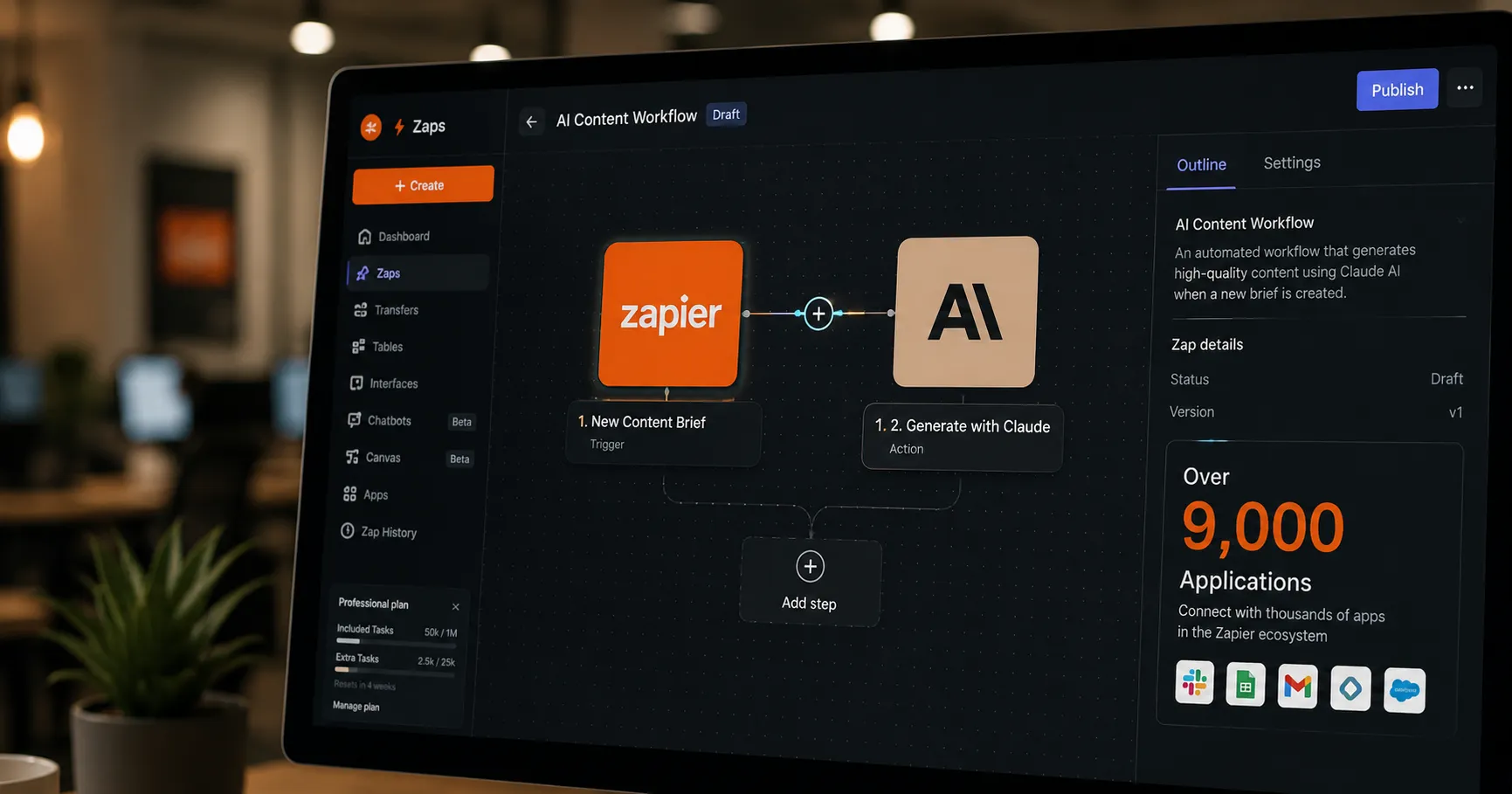
Compare AI marketing workflow tools across three tiers: no-code platforms like Gumloop and Zapier, and custom agents built with the Claude Agent SDK.
Key Takeaways
- AI marketing automation now spans a spectrum, from no-code builders to custom-coded agents that can manage an entire funnel.
- Gumloop and Zapier let you automate without code: Gumloop for AI-native agentic tasks, Zapier for connecting over 9,000 apps with AI steps.
- For full control, an AI agent SDK such as Anthropic's Claude Agent SDK lets developers build agents that use tools, run tasks, and keep memory across sessions.
On this page
AI in marketing has moved beyond generating ad copy or social media posts, and the new frontier is orchestrating entire campaigns through AI-powered workflow automation.
These platforms connect disparate tools to manage multi-step processes, from audience discovery and lead nurturing to performance optimization.
The options now range from no-code builders you can set up in an afternoon to custom agents built with code, so choosing the right AI marketing tools increasingly means picking the right tier for your team rather than a single-task app.
Beyond Single Tasks: Full-Funnel AI Automation
Traditional marketing automation relies on static, rule-based triggers, while AI workflow automation introduces adaptive systems that react to customer behavior and market shifts in real time.
This lets marketing teams build always-on campaigns that are more efficient and personalized.
According to research from Aprimo, AI can accelerate content delivery by as much as 84% by generating drafts and suggesting improvements.
Key advantages include:
- Hyper-Personalization: AI analyzes customer data to create specific segments and tailor offers to individual needs, boosting engagement.
- Enhanced Efficiency: It automates repetitive tasks like data analysis, list segmentation, and campaign scheduling, freeing up your team to focus on strategy.
- Data-Driven Decisions: AI turns raw data into actionable insights that feed directly into automated workflows, enabling faster, evidence-based adjustments.
Gumloop: An AI-Native Approach to Automation
Gumloop is designed as an AI-native automation platform, where artificial intelligence is the core engine rather than an add-on.
It provides built-in access to advanced models like GPT-4 and Claude, so you don't need to manage separate API keys.
The platform's main concept is the creation of "agentic AI automations" — autonomous digital workers that can evaluate content, make decisions, and adapt without constant human oversight.
Using its visual drag-and-drop builder, you can connect nodes to perform specific marketing tasks. Key applications include:
- Lead Enrichment: Scrape the web for information on new leads, enrich their profiles with tools like Apollo, and draft personalized outreach emails.
- Content Repurposing: Automatically convert a long-form podcast into multiple, platform-specific posts for LinkedIn, Twitter, and Instagram.
- SEO and Competitor Research: Scrape competitor sites, analyze keywords, and generate content briefs to inform your SEO strategy.
Zapier: Integrating AI into a Connected Ecosystem
Zapier is a well-known leader in no-code automation, famous for connecting over 9,000 applications through its trigger-and-action workflows, or "Zaps."
The company has integrated AI capabilities directly into its platform, letting you inject intelligence into your existing processes.
The "AI by Zapier" feature lets you add a step to any Zap that uses an AI model to analyze data or generate text, again without needing an API key.
This makes it a powerful tool for enhancing the apps you already use. Common marketing use cases include:
- Lead Qualification: Automatically score new leads based on the information they submit in a form, helping your sales team prioritize follow-ups.
- Intelligent Email Routing: Summarize long customer support emails and route them to the correct team member.
- Sentiment Analysis: Analyze customer feedback from surveys or support tickets to gauge sentiment and inform your response strategy.
Going Custom: Building Your Own AI Agent
No-code platforms cover most marketing workflows, but some teams need an agent that runs on their own infrastructure with full control over its tools and memory.
This is where AI agent SDKs come in, and Anthropic's Claude Agent SDK is a leading example.
An agent SDK is a developer library rather than a visual builder, so it sits one tier beyond Gumloop and Zapier in both power and complexity.
The Claude Agent SDK wraps the same engine that powers Claude Code and runs as a library inside your own application, with support for both TypeScript and Python.
Unlike a no-code node, an agent built this way can read and write files, run shell commands, call external services through connectors, and remember context across sessions.
That combination lets it carry out multi-step tasks on its own instead of executing a single fixed action.
Example: An Automated Content Pipeline
A practical use of a coded agent is a content creation pipeline that runs in two phases, with a person approving the work at each gate.
The diagram below shows the full flow, from a single seed topic to a finished draft.

In the ideation phase, the agent takes a seed topic, pulls keyword data such as search volume and difficulty, filters for evergreen intent, and removes ideas that overlap with existing content.
It then clusters the surviving keywords into article ideas, scores them by opportunity, and hands a ranked shortlist to a human for approval.
In the production phase, the agent studies the current top-ranking pages to find gaps, synthesizes at least three real sources into an original angle, and writes a draft that includes internal links.
The draft is pushed to the CMS as an unpublished draft, where an editor reviews and publishes it.
The pattern works because the agent handles the repetitive research and assembly while a person keeps editorial control at the two decision points.
Choosing Your Platform
The right tool depends on how much control you need and how comfortable your team is with code.
Gumloop is for building autonomous agents that perform complex analysis, Zapier is for adding intelligence to the apps you already use, and an agent SDK like Claude's is for teams that want to build a fully custom agent from the ground up.
| Feature | Gumloop | Zapier | Claude Agent SDK |
|---|---|---|---|
| Core Philosophy | AI-native, agentic automation | Connectivity-first with AI layers | Code-first, fully programmable agents |
| Best For | Complex, decision-based tasks like web scraping and data analysis | Connecting a vast number of existing apps with AI logic | Custom agents with file, shell, and tool access plus persistent memory |
| AI Integration | Built-in models are central to the platform | "AI by Zapier" is a step within a Zap | You build directly on the model with full control |
| App Ecosystem | Focused on core automation tasks | Connects over 9,000 apps | Connects via code and Model Context Protocol connectors |
| Technical Skill | Low: visual builder | Low: visual builder | High: requires development |
Choose Gumloop to create a self-sufficient digital worker for data-intensive research and analysis, choose Zapier to add intelligent lead scoring or text summarization across the thousands of apps in your stack, and choose an agent SDK when you need a custom agent with its own tools, memory, and infrastructure.
Frequently asked questions
Do I need to know how to code to automate marketing with AI?
No. Platforms like Zapier and Gumloop are no-code and use visual builders, so most marketing teams can automate workflows without writing any code. Coding is only needed if you opt for a developer SDK to gain full control.
What is the difference between a no-code tool and an AI agent SDK?
A no-code tool gives you a visual builder with preset actions, while an AI agent SDK is a developer library you program directly. The SDK offers far more control, including file access, custom tools, and persistent memory, but it requires development skills.
Can AI automate content creation from start to finish?
It can automate most of the process, such as keyword research, drafting, and internal linking, but the strongest setups keep a human in the loop to approve ideas and review drafts before publishing.
About the author
The Mixstackrr Team is a group of writers and editors with more than 10 years of combined experience in SEO and consumer tech. We test devices, dig through settings, and turn everyday tech problems into clear, step-by-step guides anyone can follow.