
Nvidia Water-Saving AI Servers: Does It Really Help?

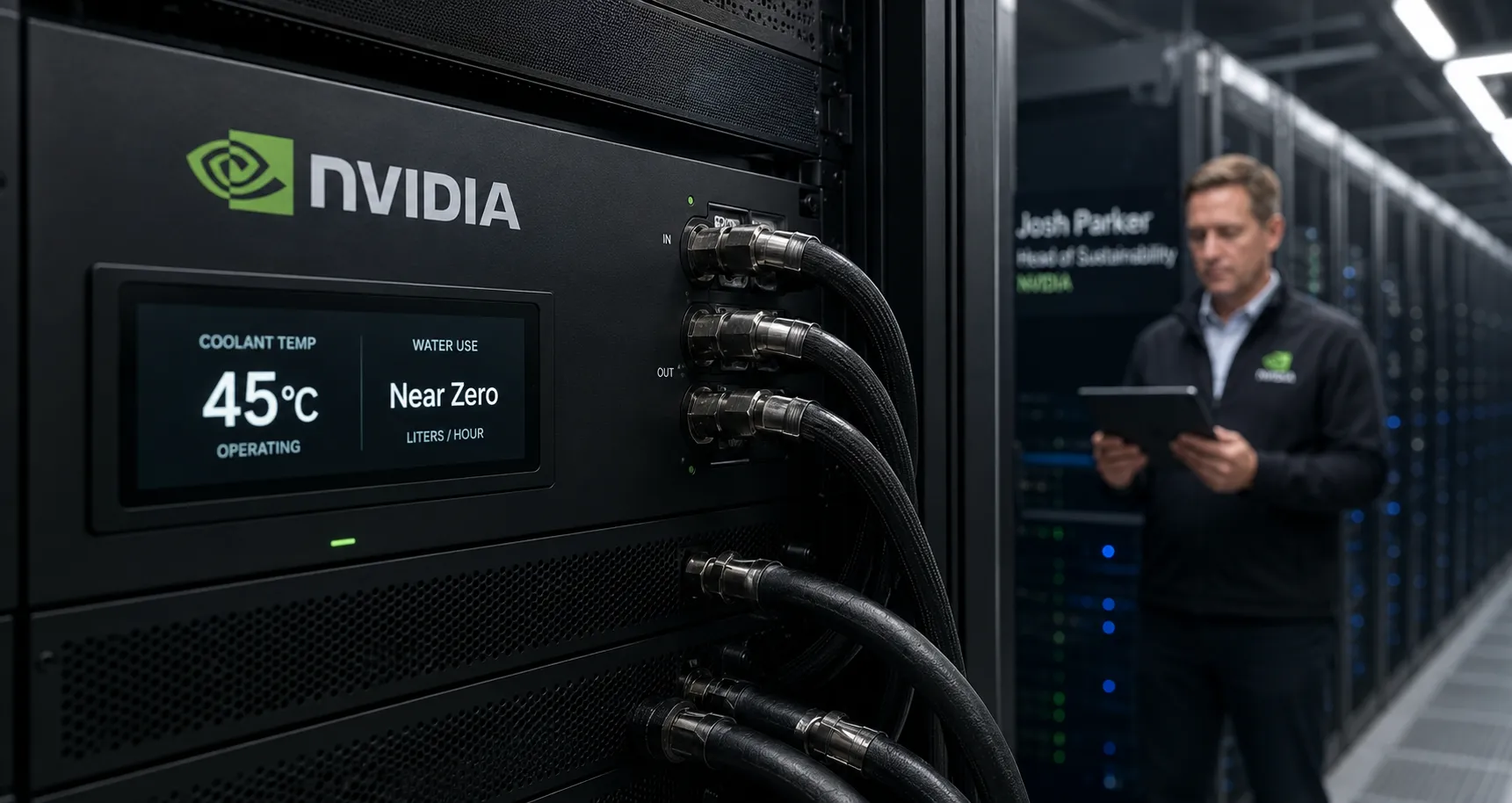
Nvidia's water-saving AI servers cut on-site data center water use to near zero, but the bigger water problem from power plants is left fully untouched here.
Key Takeaways
- Nvidia's Rubin reference design cuts on-site data center water use from roughly 2.6 million gallons per megawatt per year to near zero, a claim both The Verge and TechCrunch confirm.
- The savings only count water inside the building; power generation and chip manufacturing can double or triple a facility's total water footprint, so the fix covers about a quarter to a third of the total.
- Because fossil fuels supply about half of data center power and are heavy water users, AI's water bill is decided by the energy mix, not the cooling loop.
On this page
Nvidia's water-saving AI servers cut the water a data center uses on-site to near zero, but they do not fix AI's full water footprint.
The new Rubin-generation reference design eliminates almost all water inside the building, while the much larger water cost of generating the electricity stays exactly where it was.
Do Nvidia's Water-Saving AI Servers Actually Help?
They help inside the data center walls, and that is a real and measurable change.
Nvidia's design switches to 100% liquid cooling and runs servers hotter, which lets it cut on-site water use to what the company calls "near zero."
According to Nvidia's head of sustainability Josh Parker, the reference design takes water use from roughly 2.6 million gallons per megawatt per year for conventional cooling-tower systems down to near zero, which he frames as up to a 100% reduction (as reported by The Verge).
Both The Verge and TechCrunch confirm the same core mechanism, so the facility-level claim is not in dispute.
The catch is scope: this only counts water inside the data center, and most of AI's water is consumed somewhere else.
How the Hotter-Running Design Works
The system pumps coolant into the server racks at 45 degrees Celsius (113 degrees Fahrenheit), which is hot for a person but well within range for a chip.
After the coolant passes through a server it leaves at 55 degrees Celsius (131 degrees Fahrenheit), carrying a large amount of heat away from the hardware, per TechCrunch.
Because the loop runs that hot, outdoor dry coolers can reject the heat into ambient air for much of the year without evaporative cooling.
The coolant itself runs in a closed loop, filled once and recirculated for the life of the facility, so no new water is consumed to cool the chips.
In favorable climates, a data center built this way can run with fewer fans and chillers, which makes it more efficient and quieter on top of using less water.
What Cutting On-Site Water Does Not Fix
The savings stop at the data center's walls, and that is where the two sources part ways on framing.
The core issue is measurement: Nvidia essentially draws a line around the data center, counts what is inside, and leaves out what is outside, according to TechCrunch.
Water used outside the building, mainly in electricity generation and chip manufacturing, can double or triple a facility's total water footprint.
By that math, Nvidia's solution addresses only about a quarter to a third of an AI data center's total water consumption.
The Verge frames the announcement closer to Nvidia's own claim of eliminating "pretty much all water usage," while TechCrunch foregrounds the boundary problem, so the gap between the two coverage angles is the scope of the word "all."
Where the Real Water Goes: The Power Supply
No data center runs without electricity, and many power plants are themselves heavy water users.
Fossil fuel power plants are among the largest water consumers in the U.S., using 2.7 billion gallons per day according to the U.S. Geological Survey, most of it for evaporative cooling.
The table below normalizes the per-kilowatt-hour water cost of each power source TechCrunch cited, which is the part Nvidia's design cannot touch.
| Power source | Water use per kWh | Share of data center power |
|---|---|---|
| Natural gas | 1.17 liters | Part of ~50% fossil mix |
| Coal | 2.2 liters | Part of ~50% fossil mix |
| Hydropower (reservoir evaporation) | 6.8 liters | ~10% |
| Wind | 0.01 liters | Growing |
| Solar | 0.03 liters | Growing |
Fossil fuel plants collectively generate about half of all data center power today, according to the IEA figures cited by TechCrunch.
Hydropower supplies around 10% and does not consume water directly, but reservoir evaporation still costs about 6.8 liters per kilowatt-hour.
Wind and solar use vanishingly small amounts by comparison, which is why the energy mix, not the cooling loop, decides AI's water bill.
Why This Matters to Nearby Communities
Public pushback against data centers has centered on their water and energy use, and this design answers part of that complaint, not all of it.
Nvidia's blog post does not mention the cost of building a fully liquid-cooled facility versus a less efficient air-cooled one, a gap The Verge flagged by way of Gizmodo.
The design also does nothing for water used during construction or for the power generation that feeds the facility, which is often what affects a local water supply.
The IEA projects that natural gas and coal will supply more than 40% of the new electricity needed to meet data center demand through 2030, so the off-site water draw is set to grow regardless of cooling upgrades.
For communities near a data center, the practical takeaway is that on-site water can fall to near zero while the regional water and power strain tied to AI keeps rising, a tension that also runs through the disputes over data center testimony at Amazon.
References:
- The Verge, Nvidia says its AI data center design runs hotter to use a lot less water. Accessed on Jun 23, 2026
- TechCrunch, Nvidia wants to cut data center water use, but that’s not the same as fixing AI’s water problem. Accessed on Jun 23, 2026
Frequently asked questions
How much water does Nvidia's new AI server design save?
Nvidia says its Rubin reference design cuts on-site water use from roughly 2.6 million gallons per megawatt per year to near zero, up to a 100% reduction inside the data center, by using a closed-loop liquid cooling system.
Why do critics say it doesn't fix AI's water problem?
The design only counts water inside the data center. Water used to generate the electricity and manufacture the chips, which can double or triple the total footprint, is left out, so it addresses only about a quarter to a third of total water use.
How hot do Nvidia's water-saving servers run?
Coolant enters the racks at 45 degrees Celsius (113 degrees Fahrenheit) and leaves at 55 degrees Celsius (131 degrees Fahrenheit), which lets outdoor dry coolers reject heat without evaporative cooling for much of the year.
About the author
The Mixstackrr Team is a group of writers and editors with more than 10 years of combined experience in SEO and consumer tech. We test devices, dig through settings, and turn everyday tech problems into clear, step-by-step guides anyone can follow.