
How to Maintain Brand Voice with AI Content Generators

Maintain brand voice with AI content generators using a practical workflow to define your voice, train the AI, and scale consistent, on-brand copy fast.
Key Takeaways
- A documented style guide with core traits, approved vocabulary, and banned terms is the essential first step before using AI for content.
- Training an AI with 500-1000 words of your best-performing, cleaned content is crucial to avoid generic output and teach it your unique style.
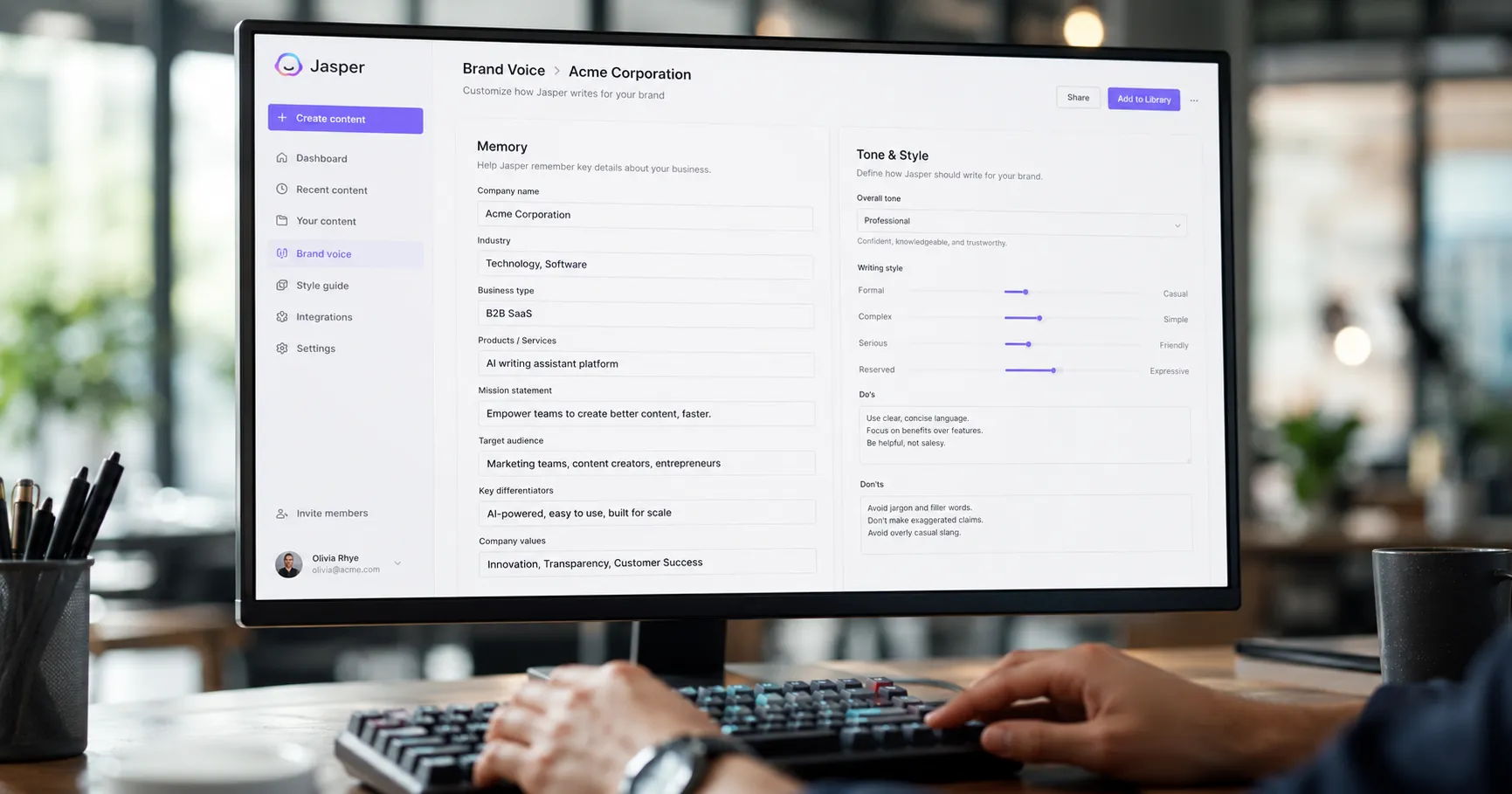
- Tools like Jasper's 'Brand Voice' feature create reusable knowledge assets that combine factual memory with stylistic rules for consistent results across all content.
On this page
AI content generators can accelerate your marketing efforts, but they often produce generic text that dilutes your brand's unique personality. The solution isn't to avoid AI, but to implement a strategic workflow that trains it to write in your specific voice. By defining your style, providing high-quality training data, and using precise prompts, you can ensure every piece of AI-generated content is consistent and recognizable.
Our editorial position is blunt: use AI to SCALE a brand voice that is already defined, not to DISCOVER one. If your voice is still vague, an AI generator will only amplify that confusion faster and across more channels.
The setup work below (a training dataset, a prompt library, a review loop) is heavy front-loaded effort, and it does not magically create consistency. It shifts the labor from writing to reviewing and editing, which is a real trade you should make on purpose.
This approach is not for everyone. If you don't yet have a corpus of high-quality, on-brand content to train on, or your output volume is small, the setup cost rarely pays back. In that situation you are better off writing manually first and building that body of work before you automate it.
Define Your Brand Voice Before You Automate
Before an AI can learn your brand voice, you must document it clearly. A well-defined style guide is the foundation for consistent AI output. This document serves as the primary source of truth for both your human team and your AI tools.
Your style guide should include several key components:
- Core Traits: Identify 3-5 personality words that describe your brand. Are you bold, friendly, analytical, or professional?
- Tone and Style: Specify whether your communication is formal or casual, optimistic or pragmatic. Include examples of sentence structures you prefer.
- Vocabulary Rules: Create lists of approved language, preferred terminology, and, just as importantly, banned terms or buzzwords to avoid. According to Dotdigital, including 'do's and don'ts' helps prevent common AI pitfalls.
- Audience Adaptation: Note how the voice should adapt for different channels, such as a technical blog post versus a social media update, while maintaining its core identity.
This step is also the cheapest place to catch a problem. If your team cannot agree on these traits in plain language, no amount of AI tooling will produce a voice the tools never received.
Train the AI with High-Quality Content
Generic AI models produce generic results. To get output that sounds like your brand, you must train the model on your own high-quality content. This process involves curating a dataset that perfectly exemplifies the voice you defined in your style guide. When choosing the right AI marketing tools, look for platforms that allow for this level of customization.
Follow these steps to prepare your training data:
- Gather Your Best Content: Collect 500-1000 words of your top-performing content. This can include blog posts, email campaigns, sales materials, and social media posts that you feel best represent your brand.
- Ensure Variety: Include a mix of formats to train the AI for different content needs. As reported by RocketSaaS, providing a varied dataset helps the model understand context and nuance.
- Clean Your Data: Remove any elements that could confuse the AI. This includes outdated language, boilerplate text like disclaimers, contact information, and other inconsistencies.
For maximum control, some platforms allow you to fine-tune a model with your proprietary data, creating a competitive advantage that is difficult for others to replicate.
This is also where the volume math bites. Curating and cleaning that dataset is a one-time cost, so a team publishing a few pieces a month will spend more on setup than it saves, while a team shipping dozens of assets a week recovers that effort quickly.
Master Prompt Engineering for On-Brand Output
Prompts are your direct instructions to the AI. The more detailed and specific your prompts are, the better the AI can align its output with your brand voice. A simple request like "write a blog post about X" will yield generic results.
Instead, craft detailed prompts that provide context and constraints. A strong prompt structure includes:
- Role: Tell the AI who to act as (e.g., "Act as the lead content strategist for Brand X.").
- Personality: Define your core traits (e.g., "Our brand personality is witty but professional.").
- Audience: Specify who the content is for.
- Goal and Format: State the objective of the content and what format it should take (e.g., "Write a product description that drives sign-ups.").
You can also use "few-shot prompting" by including a few examples of your on-brand writing directly within the prompt. This gives the AI a concrete sample to mimic. For team-wide consistency, create a library of approved prompt templates for different content types.
Leverage Built-in Brand Voice Features
Many modern AI writing platforms have built-in features designed to solve the brand consistency problem. Tools like Jasper AI, for example, offer a dedicated "Brand Voice" feature that acts as a central knowledge base for the AI.
This functionality is typically broken into two parts:
- Memory: This is where you upload factual details about your company, products, services, and target audiences. The AI uses this as a fact sheet to ensure accuracy.
- Tone & Style: Here, you provide instructions on your brand's personality, such as "Helpful, but not bossy," and upload your style guide or examples of your best writing.
This Memory plus Tone and Style split is exactly how Jasper frames the feature in its official Brand Voice announcement, separating factual recall from stylistic instruction so generated assets stay both accurate and on-brand.
Once configured, this creates a reusable "knowledge asset" that the AI references for every new piece of content it generates. Other platforms like ChatGPT (with Custom GPTs), Claude (with Projects), Gemini (with Gems), Typeface, and Anyword offer similar customization features, allowing you to create a pre-configured assistant that already knows your brand's voice without needing instructions in every prompt.
One caveat applies to all of these tools: a built-in voice profile only reflects the quality of the examples you feed it. Upload thin or off-brand samples and the feature will faithfully reproduce a thin, off-brand voice.
Ultimately, maintaining brand voice with AI is an ongoing process. It requires a solid foundation, thoughtful training, and consistent human oversight. The AI is a powerful tool, but a human editor must always have the final say to ensure the output truly connects with your audience. Treat it as an amplifier for a voice you have already defined, not a substitute for defining one, and the consistency will follow.
About the author
The Mixstackrr Team is a group of writers and editors with more than 10 years of combined experience in SEO and consumer tech. We test devices, dig through settings, and turn everyday tech problems into clear, step-by-step guides anyone can follow.