
How to Measure the ROI of Your AI Marketing Investments

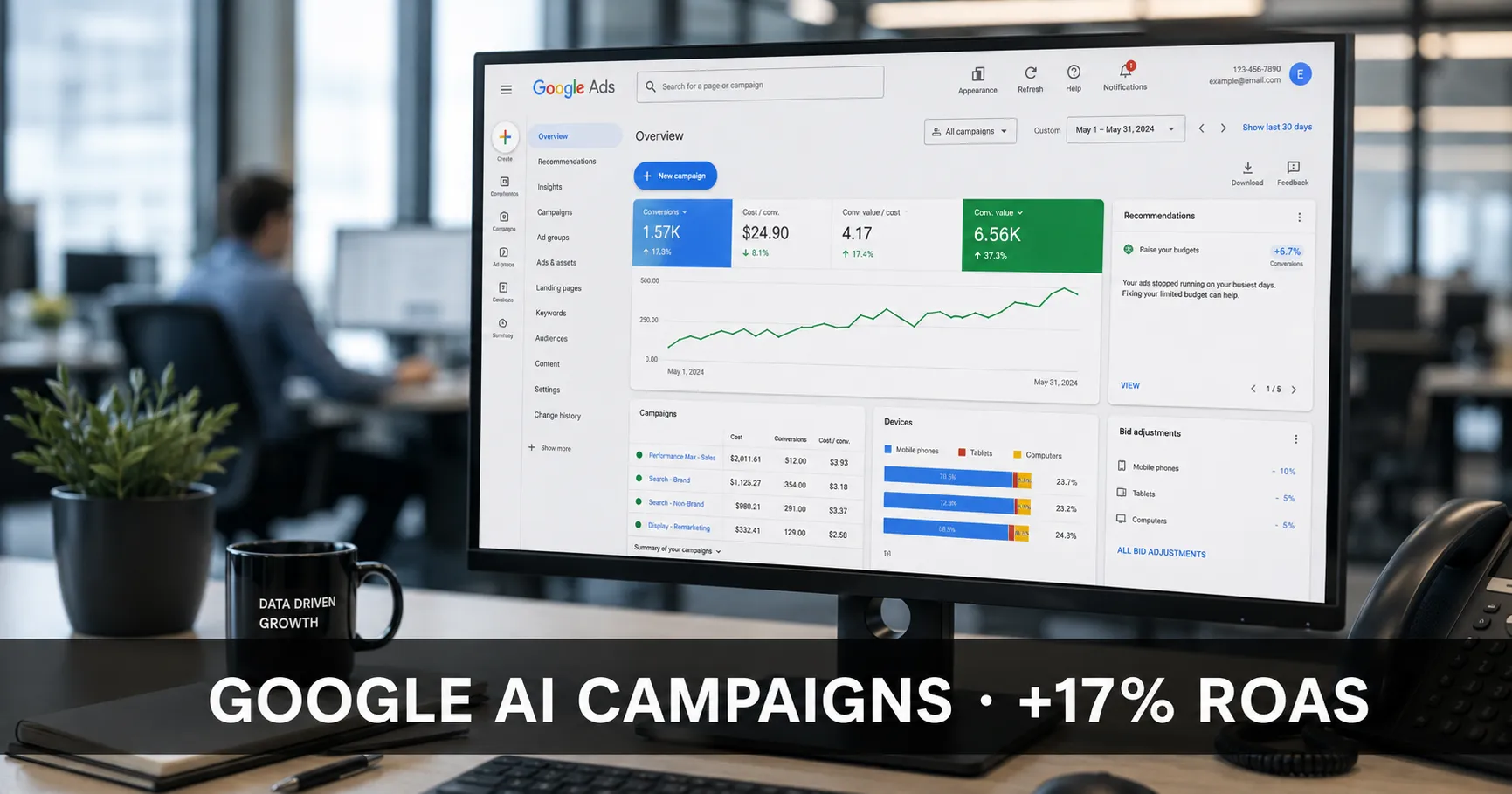
Learn to prove the value of your AI tools with clear KPIs and frameworks. This guide covers how to track conversion uplift, CPA reduction, and time savings to demonstrate the financial impact of your AI marketing investments.
Key Takeaways
- Focus on bottom-line metrics like CPA reduction (up to 50%) and conversion uplift (20-30%), not just vanity metrics.
- Quantify time savings from automation as a direct productivity gain that frees up your team for more strategic work.
- Use a structured framework that starts with business outcomes to build a compelling case for any new AI investment.
On this page
To justify spending on artificial intelligence, you need to prove it delivers tangible business value. Measuring the return on investment (ROI) of your AI marketing tools is essential for securing budgets, optimizing strategy, and transforming AI from an experiment into a core revenue driver. The key is to move beyond vanity metrics and focus on KPIs that directly impact the bottom line.
Key Metrics for AI Marketing ROI
A successful measurement strategy blends financial, operational, and customer-centric data. Companies that effectively leverage AI in marketing report 20-30% higher ROI on campaigns compared to traditional methods. Here are the critical KPIs to track.
Conversion Rate Uplift
AI excels at personalizing content and user experiences to drive action. By tracking conversion rates, you can directly measure this impact. According to Landingi, businesses using AI can see conversion rates increase by as much as 20-30%. For example, AI-powered chat solutions have been shown to lift conversion rates from 3.1% to 12.3%. This is achieved by adapting landing pages in real-time and rapidly A/B testing elements to find what works best.
Cost-Per-Acquisition (CPA) Reduction
Lowering the cost to acquire a new customer is a powerful way to demonstrate ROI. AI-driven marketing tools can reduce customer acquisition costs (CAC) by an average of 37%, with some organizations reporting reductions up to 50%. This efficiency comes from using predictive analytics to identify high-value audiences, which minimizes wasted ad spend and optimizes bidding strategies.
Time Savings and Productivity Gains
One of the most immediate benefits of AI is automating repetitive tasks. This includes content generation, lead scoring, and campaign reporting. Quantify this by tracking the hours your team reclaims from manual work, which can then be reallocated to more strategic initiatives. Some teams see an 84% faster content delivery timeline after implementing AI tools.
Incremental Revenue and Return on Ad Spend (ROAS)
To isolate AI's financial contribution, compare the performance of AI-optimized campaigns against your traditional marketing efforts. AI-driven personalization alone can boost revenue by 5-15% and deliver five to eight times the ROI on marketing spend. For paid advertising, this translates to a higher ROAS. As reported by CI Web Group, Google's AI-powered campaigns deliver a 17% higher ROAS on average.
Customer Lifetime Value (CLV) and Engagement
AI also drives long-term value. By using AI for churn prediction models and hyper-personalized retention offers, you can increase CLV. Monitor engagement metrics that serve as leading indicators, such as open rates and click-through rates (CTR). AI-driven campaigns have demonstrated a 131% increase in CTR and helped businesses generate a 451% increase in qualified leads.
A Framework for Your AI Business Case
Before you can measure ROI, you need a solid business case to secure investment. A structured framework ensures your AI initiatives are aligned with strategic goals.
The most effective approach is to start with business outcomes, not technology. Identify specific challenges or high-value opportunities where AI can make a clear impact. This ensures every tool you adopt is chosen to solve a real problem. When evaluating technology, it's also important to consider the strategic implications of your choice. Relying on a single platform can introduce AI model risk, where a vendor's failure becomes your failure.
A simple but effective framework evaluates potential AI projects across three dimensions:
- Business Value: Does it generate revenue, reduce costs, or improve efficiency?
- User Experience: Is it desirable and does it solve a real problem for the user (internal or external)?
- Technology Feasibility: Do you have the data, skills, and integration capabilities to make it work?
By prioritizing projects that score high in all three areas, you can build a strong, defensible business case. This makes proving the financial impact of your AI marketing investments a clear and repeatable process.
About the author
The Mixstackrr Team is a group of writers and editors with more than 10 years of combined experience in SEO and consumer tech. We test devices, dig through settings, and turn everyday tech problems into clear, step-by-step guides anyone can follow.