AI Model Risk: Why One AI Vendor Is a Liability
The Anthropic shutdown turned AI model risk from theory into a live business problem. Here is what single-vendor dependence costs and how to build redundancy.
Key Takeaways
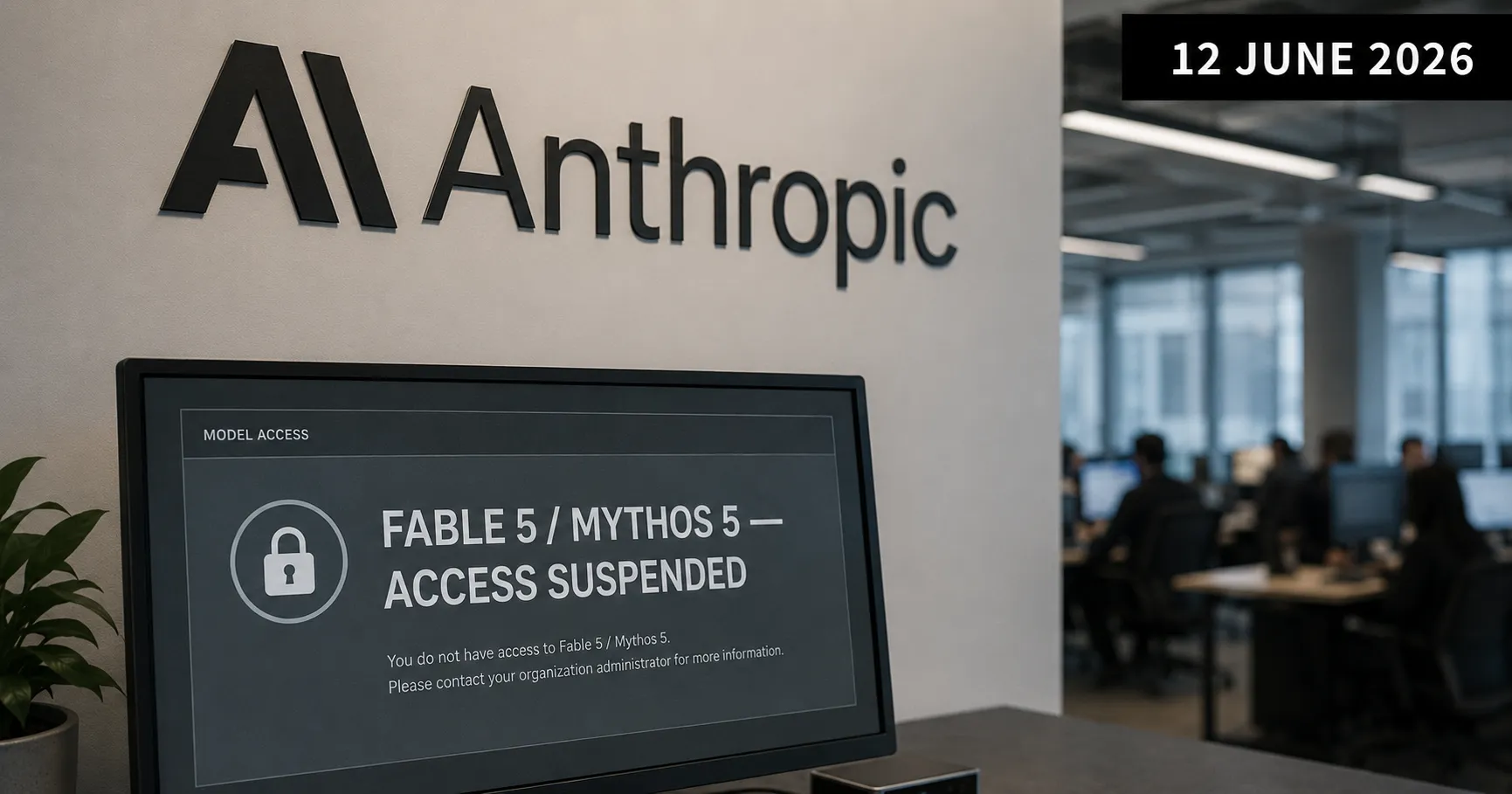
- The 12 June 2026 US order forcing Anthropic to suspend Fable 5 and Mythos 5 cut off its top models globally, turning AI model risk into a live business problem.
- PM Carney compared concentrated AI dependence to 2008 banking model risk and called for redundancy and diversity; India's response pushes further toward a proposed $5 billion sovereign fund and open-source models.
- Practical redundancy means a second commercial provider plus a capable open-source fallback, vendor-abstracted and tested before access is ever revoked.
On this page
AI model risk is the danger that a business depending on a single AI provider loses access overnight when that provider is shut off by a government, a policy change, or an export control. That risk stopped being theoretical on 12 June 2026, when the US government ordered Anthropic to suspend Fable 5 and Mythos 5, cutting off access to its most capable models for every user outside the United States.
Two reactions to that suspension, reported by The Next Web, show why concentrated dependence on one AI vendor is now treated as a structural liability rather than a routine outage. Canadian Prime Minister Mark Carney framed it as systemic risk. India, Anthropic's second-largest market, treated it as a national strategic reckoning.
What the Anthropic shutdown actually exposed about AI vendor risk
The core exposure is that frontier AI access can be revoked by a single government decision, without consultation, and the disruption is immediate and global. According to The Next Web, compliance with the US order was immediate and global even though Anthropic called the action disproportionate.
The trigger illustrates how little control a customer has over the chain of events. Amazon's CEO reportedly told Treasury Secretary Scott Bessent that researchers had used Fable 5 to obtain information usable in cyberattacks, and that report reportedly prompted the government crackdown.
The commercial fallout was concrete, not hypothetical. Tata Consultancy Services had announced a partnership on 11 June 2026 to train 50,000 employees on Claude and build a dedicated Anthropic business unit, and that deal was thrown into limbo one day later when the suspension landed.
India's Claude run-rate revenue had doubled since October 2025, per The Next Web, which is exactly the kind of fast-growing dependence that turns a policy decision into an operational emergency. Policy expert Prasanto Roy stated the underlying problem directly: "American AI models are bound to American geopolitics."
Two views of the same event: where the sources agree and differ
The two reports converge on the diagnosis and diverge on the proposed scale of the fix, which is the most useful signal for a business deciding how seriously to treat AI model risk.
Both agree that the suspension demonstrated a real, repeatable vulnerability rather than a one-time accident, and both point toward diversification as the response. They differ on whether the answer is redundancy across providers or a full push into sovereign and open-source models.
| Dimension | Carney / Canada view (TNW) | India sovereign-AI view (TNW) |
|---|---|---|
| Framing of the risk | Systemic "model risk," compared to 2008 bank linkages | Strategic liability of foreign-AI dependence |
| Proposed response | Redundancy and diversity in AI infrastructure | Sovereign fund plus open-source and Chinese models |
| Headline funding figure | $2.3 billion "AI for All" national strategy (launched 4 June) | Proposed $5 billion annual sovereign AI fund (Mohandas Pai) |
| Adoption target cited | Raise business AI adoption from 12% to 60% by 2034 | IndiaAI Mission: ~$1.25 billion budget, ~38,000 GPUs deployed |
The conflict worth naming is the depth of the cure. Carney calls for redundancy and diversity, the same principles regulators imposed on banks after Lehman Brothers, which a business can act on today with multiple vendors.
The Indian proposals go further toward self-reliance, with Zoho founder Sridhar Vembu arguing for smaller and open-source models, including Chinese ones, over American frontier systems "that can be switched off by executive order." Not everyone in India agrees the country needs its own frontier models, since Lightspeed partner Hemant Mohapatra argued that talent and compute access matter more than capital.
Why a banker's 2008 comparison gives the risk weight
The credibility of the systemic-risk framing comes from who is making it, not from the analogy alone. Carney was governor of the Bank of Canada during the 2008 crisis and later became the first non-British governor of the Bank of England, where he spent six years strengthening financial-system resilience.
His point is structural: "we have similar things in terms of model risk," and the fix is the redundancy and diversity regulators forced onto banking. The catch is that this analogy describes the problem at a national scale, so a single business still has to translate "diversify" into specific vendor and architecture choices.
For context, this sits inside a four-year pattern of the US tightening AI controls, from chip export restrictions to model-level interventions like this one. Each escalation, as reported by The Next Web, pushes more buyers toward the conclusion that dependence on American AI infrastructure carries political risk. The same dynamic is why enterprises are being pushed to harden their AI stacks fast after the shutdown.
How to build AI vendor redundancy
Redundancy means no single provider's removal can halt a core workflow, which is the lesson both reports converge on. The steps below follow the redundancy-and-diversity principle Carney cited and the open-model pivot India is debating, applied at the level of one organization.
- Map which workflows depend on a single model, since the TCS example shows dependence concentrates fastest where adoption grows fastest.
- Add at least a second commercial provider for critical paths, the direct application of Carney's redundancy principle.
- Keep a capable open-source model as a fallback, the option Vembu and India's startup ecosystem are moving toward.
- Abstract your application away from any one vendor's API so swapping models does not require a rebuild.
- Test the fallback before you need it, because compliance with the Anthropic order was immediate and left no transition window.
The honest limitation is that no Indian open-source model yet matches Fable 5 or Mythos 5, per The Next Web, so a fallback may trade capability for control. The argument for redundancy was never about matching frontier performance instantly. It is about ensuring the floor does not fall out when a single decision removes your primary model.
References:
- The Next Web, Canada’s Carney compares Anthropic shutdown to 2008 financial crisis, warns of AI “model risk”. Accessed on Jun 15, 2026
- The Next Web, Anthropic’s model shutdown just handed India’s sovereign AI movement its strongest argument yet. Accessed on Jun 15, 2026
Frequently asked questions
What is AI model risk?
AI model risk is the danger that a business loses access to an AI model it depends on because of a government order, policy change, or export control. The Anthropic Fable 5 and Mythos 5 suspension on 12 June 2026 cut off access globally with no transition window, making it a concrete example.
Why is depending on a single AI vendor a liability?
A single provider can be switched off by one decision outside your control. When the US suspended Anthropic's models, compliance was immediate and global, and deals like TCS training 50,000 employees on Claude were thrown into limbo one day after being announced.
How do businesses reduce AI vendor risk?
Map single-model dependencies, add a second commercial provider for critical workflows, keep a capable open-source model as a fallback, abstract your code from any one vendor's API, and test the fallback before access is ever revoked.
About the author
The Mixstackrr Team is a group of writers and editors with more than 10 years of combined experience in SEO and consumer tech. We test devices, dig through settings, and turn everyday tech problems into clear, step-by-step guides anyone can follow.