
Choosing the Right AI Marketing Tools: A Practical Framework

Struggling to choose from thousands of AI marketing tools? This practical framework helps you evaluate software based on ROI, integration, and business needs.
Key Takeaways
- Focus on solving a specific business problem before evaluating any AI tool to avoid chasing hype and ensure a clear ROI.
- Prioritize a tool's ability to integrate with your existing tech stack; a standalone tool often creates more work than it saves.
- Use a weighted scoring system that values integration, security, and total cost of ownership, not just surface-level features.
On this page
The AI marketing tool market is projected to reach $107.5 billion by 2028, yet a staggering 95% of enterprise AI pilots fail to deliver any measurable return on investment. The reason is simple: teams often choose tools based on hype rather than a structured plan. Selecting the right software isn't a technology decision - it's a revenue and operations decision.
This guide provides a step-by-step framework to help you choose AI marketing tools that measurably improve efficiency, decision speed, and customer experience.
Step 1: Define Your Core Problem, Not the Tool
Before you watch a single demo, you must clearly define the problem you are trying to solve. Start with a specific business decision where uncertainty or delay hurts performance. This could be budget allocation, creative optimization, or diagnosing funnel drop-offs.
Translate these challenges into measurable outcomes. Your goal might be a higher conversion rate, a lower customer acquisition cost (CAC), or faster reporting cycles. This clarity ensures you adopt AI to fill real operational gaps, not just for the sake of experimentation.
Ask your team these critical questions first:
- Where do we spend the most time on repetitive, low-value tasks?
- What are our biggest performance gaps across content, paid ads, SEO, or email?
- Which decisions are we making too slowly that AI could accelerate?
- What does a successful implementation look like in 90 days?
Step 2: Map Your Needs to the AI Tool Landscape
The AI marketing ecosystem is vast, with different tools designed for specific functions. Understanding these categories helps you narrow your search to platforms that align with the problem you identified in the first step.
Here are the main categories of AI marketing tools and their primary use cases:
| Category | Examples | Use Case |
|---|---|---|
| Content Generation | Jasper, Copy.ai | Blog posts, ad copy, social media captions |
| SEO & Search | Surfer SEO, MarketMuse | Keyword research, content optimization |
| Email Marketing | Reply.io, Klaviyo | Personalized outreach, send-time optimization |
| Analytics | Improvado AI | Unified dashboards, plain-English data queries |
Start with your goals. If you need to scale creative output, focus on content generation tools. If you need to improve customer segmentation, look for platforms with embedded AI for email or analytics.
Before You Buy: One Customizable Model Across Several Categories
The table above assumes a clean split, one specialist tool per job. That split is real, but it hides a second option that has only recently become practical: a single general-purpose model you connect to your own data and point at several of those jobs at once.
The logic is straightforward. Most of what those category tools sell is a reasoning, generation, and analysis layer wrapped around one workflow. A capable model like Claude can supply that same layer across content, SEO, reporting, and analysis, as long as you give it access to the data it needs to reason over.
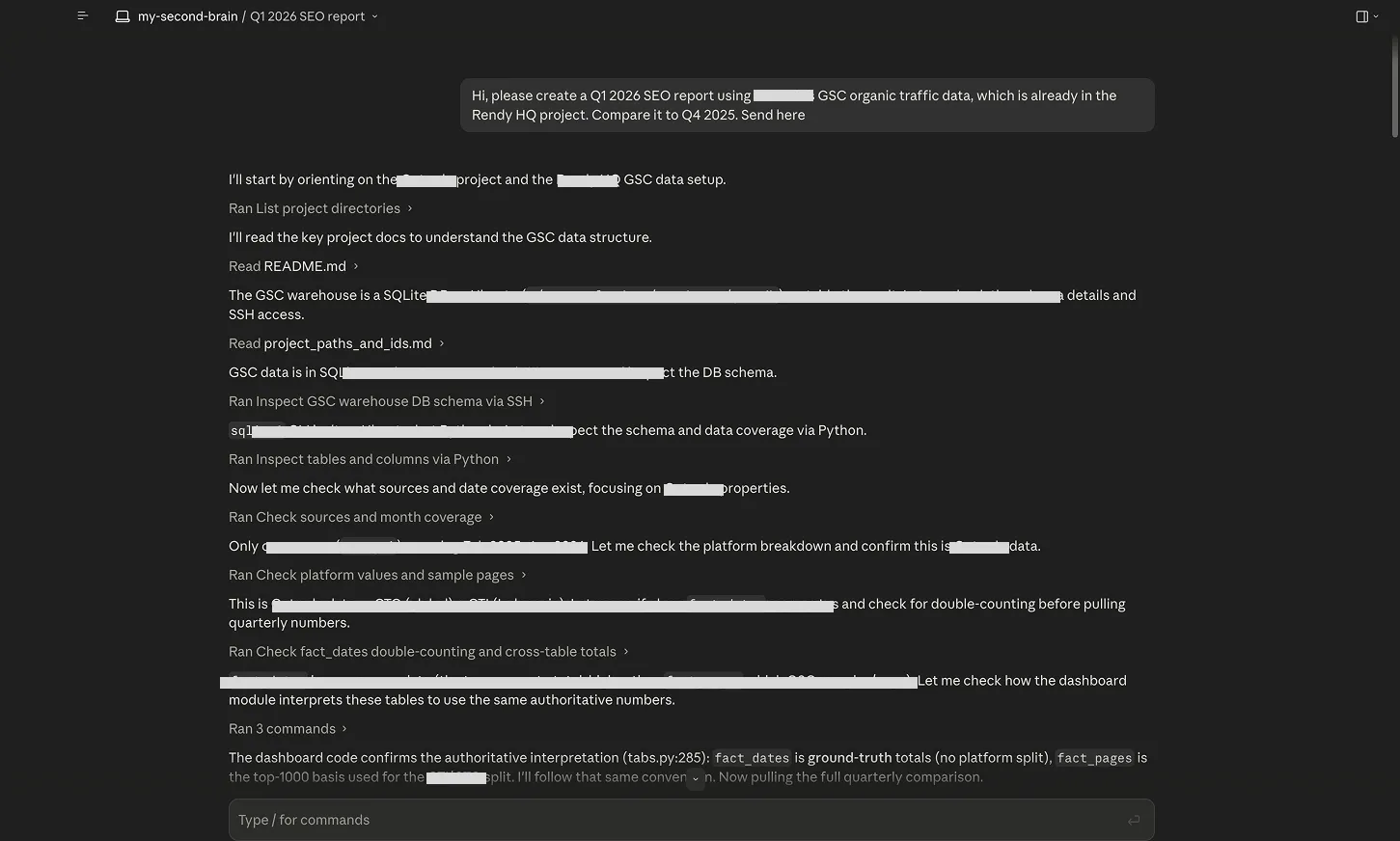
Here is a worked example from our own setup. We connected Claude Code to a data warehouse that already held our Google Search Console data, gave it a short set of project docs describing where the tables lived, and asked it to build a quarterly SEO report.
It read the schema on its own, checked for double-counting across tables before trusting any totals, found the authoritative numbers the internal dashboard already relied on, and returned a Q1 2026 versus Q4 2025 comparison with the analysis attached rather than just the figures. One thing it surfaced: impressions had grown roughly 11x while clicks grew about 2.8x, which forced CTR down and pushed average position lower. That is a diagnosis, not a dashboard reading.
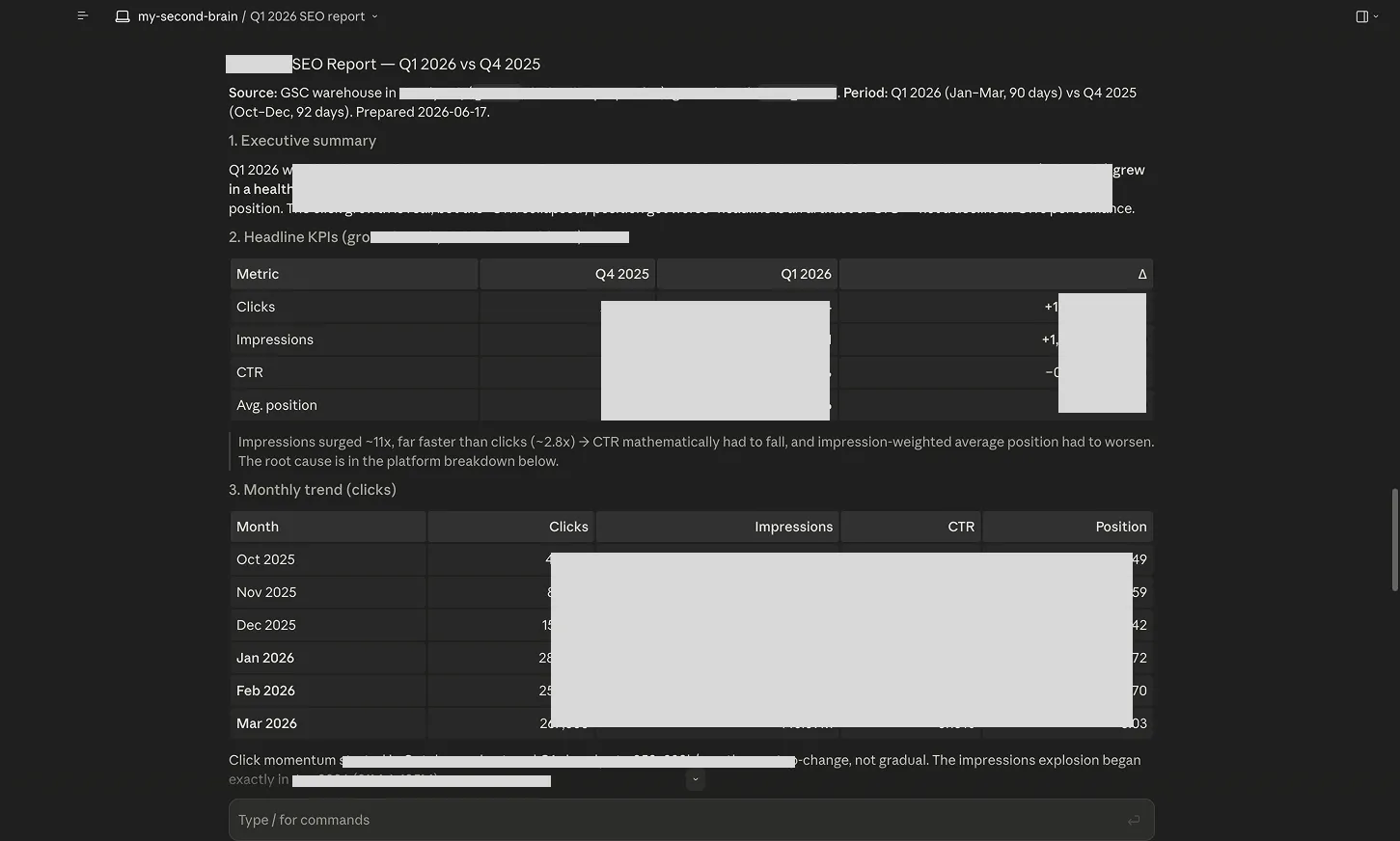
The same connection handles far more than reporting. Off that one data source, the work spans keyword research, content optimization, strategic analysis, and the report above, jobs the landscape table would otherwise route to three or four separate subscriptions.
This path is not free, and it does not replace everything. Two limits decide whether it fits you.
First, a general model brings the thinking layer, not proprietary data. A dedicated SEO platform owns a keyword-volume database and a backlink index. An email platform owns sending infrastructure and deliverability. A model wired to your warehouse reasons over the data you already have, it does not hand you a dataset you lack or run a sending pipe you do not operate. Where the moat is data or infrastructure, the specialist still wins.
Second, "connect it to your data" is the hard part, not a footnote. In the example above it meant SSH access to a warehouse, documented table locations, and a person who could verify the output instead of trusting it blindly. Turnkey category tools exist precisely because most teams cannot or will not do that setup. If nobody on your team can build and maintain the connection, this option stays theoretical, and a specialist tool is the honest call.
So treat the generalist route as a genuine decision point, not a default answer. If your bottleneck is reasoning over data you already control, one customizable model can collapse several line items into a single setup. If your bottleneck is data you do not own or infrastructure you do not run, buy the specialist. Either way, score both against the weighted framework in the next steps rather than assuming the category map is the only shape this decision can take.
Step 3: Prioritize Integration with Your Existing Stack
A powerful AI tool that doesn't connect with your existing systems creates more problems than it solves. According to a report by Improvado, companies that strategically integrate AI see an average 37% reduction in costs and a 39% increase in revenue. These gains only happen when you move beyond isolated tools to a cohesive tech stack.
Many teams already suffer from tool sprawl. Research shows 44% of B2B marketing professionals juggle between five and ten different tools. Adding another disconnected platform only increases complexity. To avoid this, audit your integration readiness:
- Map your current stack: Identify your existing tools, find redundancies, and pinpoint data bottlenecks.
- Check API and data compatibility: Ensure any new tool can seamlessly connect with your customer data sources and automation platforms.
- Involve all stakeholders: Assemble a team from marketing, data, and IT to ensure the tool meets everyone's requirements.
Step 4: Create a Weighted Evaluation Framework
To make an objective decision, score potential tools using a weighted framework. This method forces you to prioritize what truly matters for your business instead of getting distracted by flashy features. It also helps you consider long-term factors like AI model risk and vendor stability.
Here is a sample framework to adapt for your needs:
- Core Use Case Fit (30%): How well does this tool solve the specific problem you identified in Step 1?
- Integration Capabilities (25%): Does it have native integrations or a robust API to connect with your existing stack?
- Security and Compliance (20%): Does the vendor meet your organization's data security and privacy standards?
- Total Cost of Ownership (15%): What is the full cost, including implementation, training, and subscription fees?
- Vendor Stability and Support (10%): Is the vendor well-established and do they offer reliable customer support?
By following a structured process, you can confidently select AI marketing tools that deliver tangible results and become a competitive advantage, not just another subscription on your credit card.
About the author
The Mixstackrr Team is a group of writers and editors with more than 10 years of combined experience in SEO and consumer tech. We test devices, dig through settings, and turn everyday tech problems into clear, step-by-step guides anyone can follow.